Lights out again, fridge warming up, and you are hunting for a flashlight in the junk drawer.
Every house in this town has four flashlights in a drawer and not one working battery in any of them, which is a rough way to find out you wanted solar battery backup. We put batteries on homes all over the metro, tied to new arrays and to systems somebody else installed years ago, and the part people learn the hard way is that a battery is not one size fits all.
Spring storm season here knocks power out for three hours some nights and for two days others. Those are two different jobs.
So before I put a number on anything, we pull a year of your usage and walk the house to see what truly has to stay alive: refrigerator, well pump, CPAP machine, one window unit, the router. I refuse to hang a battery off a guess and let you discover during an outage that the kitchen is dark.
Whether a home battery backup carries a critical loads subpanel or the entire house, how many kilowatt-hours you want to store, and where the cabinet can safely mount move the cost far more than the label on the box.
Keep going down the page for how the install actually runs, what it takes, when a battery is the wrong answer, and what folks ask me first. Or call and I will come look.
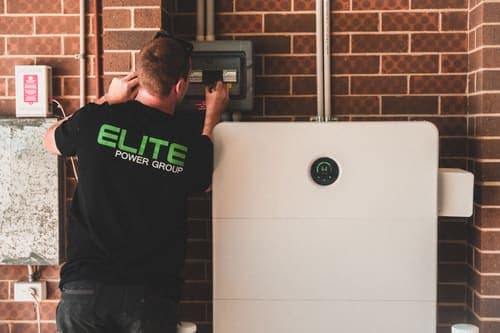
Solar Battery Storage
Solar battery storage is the piece that decides what stays alive when the lights go out, and sizing it is a load exercise, not a guess. We walk the house and add up what you want running at two in the morning: refrigerator, the mini split or a window unit, well pump if you're on one, CPAP, router. Ten kilowatt-hours will carry a fridge and lights overnight.
Keeping a heat pump going through a summer outage takes considerably more cabinet, plus an inverter with the surge to start the compressor.
Most of the work our solar installation company does here ties storage into panels already on the roof, which changes the wiring at the main.
Where solar battery backup goes wrong is a battery wired to the whole panel with no critical loads subpanel, so the range and the dryer drain it in an hour. Kilowatt-hours, cabinet count, inverter compatibility and the meter-side work are what push a home battery backup price around.
Residential Energy Storage Systems
Residential energy storage systems start with a list, not a product. Before I pick a box, I want to know which circuits you actually need alive when the power goes: the refrigerator, the well pump if you have one, a window unit or two, the router so nobody in the house asks you about the router. That list sizes your home battery backup and it drives every decision after it.
We hang most batteries in a garage or on a shaded exterior wall. Lithium iron phosphate cells handle a Birmingham summer in an unconditioned garage just fine, but bake them on a west-facing wall with no shade and you give up capacity you paid for. The failure I see on other people's work is a battery tied to the whole panel with no critical loads subpanel behind it, so a cloudy stretch drains the thing before supper.
What moves the cost of solar battery backup is how many circuits get carried over, how far the battery sits from the main panel, and whether that panel has any room left to work with.
What the job involves
A solar battery backup job starts at your breaker panel, not on the roof. We go through the box together and decide what has to stay alive when the power drops: fridge, well pump, the internet, a few outlets, maybe the air handler if the battery can carry the compressor surge. That list becomes a critical loads subpanel, and that subpanel is where most of the labor hides.
Then we pick a wall. A west-facing garage wall in the middle of a Birmingham summer will cook a battery into derating itself right when you want it most, so we look for shade or conditioned space instead.
After that it's conduit, rapid shutdown, the permit, inspection and the power company's sign-off, then commissioning and getting the app on your phone. Start to finish it runs weeks, not a morning.
What moves the cost: how many cabinets, whole-house or partial backup, the age of your panel, and whether an enphase solar battery has to tie into gear already on your roof.
What it costs
What a solar battery backup runs comes down to two things: how many kilowatt-hours you want hanging on the wall, and how much of the house you expect them to carry. Keeping the fridge, a few lights, the internet and the well pump alive is one number.
A whole house battery that holds central air through a sticky afternoon outage is a bigger one, because that usually means more than one unit, more inverter capacity, and work inside the main panel.
Past that, price moves on whether your existing solar inverter can be coupled to a battery or has to be swapped, how far the batteries sit from the meter, how hot the mounting wall gets, and what the power company's paperwork asks for.
Undersizing is the costly mistake. A bank sized for lights won't start a compressor, and you find that out in the dark.
Call us with your breaker panel and a list of what you want running, and we will size it and price it.
When solar battery backup is the wrong fix
Solar battery backup is the wrong fix more often than people expect, and I'd rather say so now than after the cabinet is on your wall.
If your array is already underproducing, storage just banks less of nothing. That's a solar panel repair conversation first, inverter faults, a shaded string, a dead optimizer, and until that's sorted a battery is an expensive shed for empty boxes.
If the power goes out at your place for four and five days at a stretch and you've got a well pump and a heat pump that have to keep running, a home generator installation will carry that load longer than a whole house battery of any sensible size.
If the actual complaint is that your car charges slowly, that's an ev charger installation and likely a service upgrade, not storage.
And if there's no utility line to the property at all, you want an off grid solar system sized around cloudy stretches, which is a different design entirely.
Why choose us for this
You already sat through one quote for solar battery backup and walked away knowing less than when you started. What you want isn't craftsmanship talk. You want to hire somebody once, have the cabinet on the wall doing its job, and not think about it again for years.
What changes our number is how many circuits you want carried, how far the battery ends up from your main panel, whether your existing inverter can talk to it, and what shape the breaker box is in. A cheaper sheet usually gets there by leaving off the separate panel for your backed-up circuits and the paperwork with the power company. Those don't vanish. They just show up later as a change order.
What we will not do is size residential energy storage systems off a wish list instead of your actual usage, then let you discover in an August outage that the air conditioner trips the whole thing.
Quoting costs nothing and puts you on no schedule.
Frequently asked questions
What appliances can't I run on solar battery backup?
Anything with a huge startup surge. A single battery will carry your fridge, well pump, internet, lights and most outlets for a day or two without blinking. Central air is the one that bites people in August, so we either add a second unit, fit a soft starter on the condenser, or leave the AC off backup and keep the rest alive.
Will adding a battery mess up the solar array I already have?
No. Nearly all of our work happens at the panelboard and the inverter, not on your shingles. If your existing string inverter can't talk to storage, we AC couple the battery alongside it and build a small subpanel for the circuits you actually want lit. Your power is down for part of one day during the cutover.
How do we get started?
A site visit. We read your last twelve months of bills, count the circuits you want backed up, check any tesla powerwall rebate you qualify for, then size it. Installation runs weeks, not a morning.
Contact Birmingham Solar Installation now
If you want a Birmingham solar installation crew to come out and look at solar battery backup for your own house, the number is (205) 883-0490. Somebody is at the desk nine to five, Monday through Friday, and a message left after that gets a call back.
Two things help before we show up. First, which circuits you genuinely cannot live without: the fridge, the well pump, the internet, one window unit and the bedroom outlets is a much smaller build than keeping the whole place lit, and it changes how many batteries end up on your wall. Second, a recent power bill, so we can see what your house actually draws in the hot months instead of guessing.
On the visit we pull the cover off the service panel, read the main breaker rating, and hunt for a mounting spot that does not cook. A garage wall on the shaded side is fine. An attic that sits well over a hundred degrees through the summer will shorten the life of the cells, and I will say so rather than hang it there.
We handle the permit and the utility interconnection paperwork. We hold a current license, and the insurance certificate is yours if you ask for it.