Forty miles overnight from a garage outlet, and you still leave for work with a half-empty battery.
Most of the EV charger installation calls we take in Birmingham start right there: you bought the car, the dealer handed you a cord, and that cord fills the battery about as fast as a garden hose fills a pool. A level 2 ev charger installation turns an overnight problem into a non-problem, which matters if your commute involves 280 and Malfunction Junction twice a day.
We do electrical and solar work, and a charger is the heaviest single load most houses will ever carry, heavier than the dryer or the range. So we start at your panel, not at the wall you had in mind.
What moves a level 2 charger cost is the run from panel to parking spot, whether there's breaker space left, and whether we're pulling through a crawl space or drilling brick.
Below is how the work goes, what it runs, and the questions people ask before booking. Call and we'll come open your panel and look.
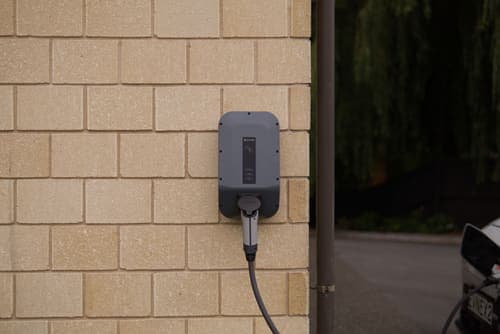
Level 2 Ev Charger Installation
A level 2 ev charger installation is a 240-volt circuit, and everything that matters happens between your breaker panel and the wall where you park. We start with a load calculation on your existing service, because a house with a heat pump, an electric range and a dryer already has promises to keep.
If there's capacity, we land a 40 or 60 amp breaker, pull the right gauge copper in conduit, and set the unit where the cable reaches your charge port without dragging across the slab. You go from about four miles of range an hour on a wall outlet to twenty-five or thirty. A tesla wall connector installation sits on that same circuit, so the work behind the drywall doesn't change much.
What fails is undersized wire on a long run and a bargain receptacle that browns at the contacts after a year of steady charging. On any ev charger installation, the length of that run and whether your panel has room move the price more than the charger does.
Home Ev Charging Station Installation
Home ev charging station installation comes down to one question: where does your car actually sit at night, and how far is that from your panel? Most of what we run is a 240-volt circuit out to a garage wall, a carport post, or the side of the house where you back in. On the 1920s bungalows around Forest Park still on hundred-amp service, the conversation starts with capacity.
On a newer house it is usually just the length of the run.
Done poorly, the conductor gets undersized for a long pull and the breaker starts nuisance tripping on a 95-degree afternoon. Or the unit lands in a spot where the cord barely reaches the port, so you park crooked for the next ten years. We measure mounting height and cord reach against your car, in your driveway.
A straightforward ev charger installation is most of a day. Distance, masonry walls, crawlspace access and panel capacity are what stretch it. As the ev charger electrician on the job, the permit and inspection are mine to handle.
Ev Charger Electrician
You want an ev charger electrician on this one, not a neighbor with a spool of wire and a YouTube video open on his phone. A car charging circuit pulls near its full rating for hours at a stretch, which is nothing like a dryer or a window unit cycling on and off. Undersized conductors run hot, the insulation dries out, and the breaker starts tripping at two in the morning when you needed a full battery by seven.
So before anything gets mounted, I do a real load calculation on your existing service, size the copper for continuous draw, and pull the permit so an inspector puts eyes on it.
Distance and access change the price of an ev charger installation more than the charger itself does. A garage wall backing right onto the panel is straightforward. A detached garage across the yard, with a trench and a concrete driveway between us, is a different piece of work and I will tell you that up front.
Hard Wired Ev Charger
A hard wired ev charger skips the outlet entirely. The conductors come out of the conduit and land straight on the charger's terminal block, so there's no cord cap, no receptacle face, and nothing behind the drywall slowly working loose every time you unplug.
Hardwiring is also the only way to run most units at full output, and outdoors on a carport it's the sane choice, because our summers will chew up a cheap outdoor receptacle in a couple of years.
The plug-in failure I see most is a bargain fifty-amp receptacle built for an RV that connects twice a season, not a car drawing forty amps for six hours a night. They come out of the wall brown and soft around the blades.
Before quoting an ev charger installation I run a load calculation on your existing service. That math is the unglamorous half of being an ev charger electrician, and it's the half that decides whether this is a conduit run or a bigger conversation. Price follows the length of that run, what it has to pass through, and how much room the panel has left.
What the job involves
An ev charger installation is mostly a wiring job with a charger bolted on the end. We start at your panel: how big the service is, whether there's room for a two pole breaker, and what else in the house wants power at six in the evening. Plenty of the older houses over on Southside are still on a hundred amp service with a full panel, and that gets solved first.
Then the run. Conduit or cable from the panel to the wall where the car actually sits, sized for the distance and the amperage rather than whatever was left on the truck. Undersized conductors on a long run heat up and drop voltage, and you end up charging slower than the box on the wall claims.
Distance, finished walls, a crawl space full of ductwork, or a trench out to a detached garage are what move the labor. A hard wired ev charger also gets landed to torque spec, permitted and inspected.
What it costs
What it costs on an EV charger installation comes down to a short list, and the top of that list is the distance between your breaker panel and where the car actually sits. A ten foot run in an open basement is one afternoon. Fishing wire through a finished ceiling in an older Southside house and out to a detached garage, sometimes with a trench across the yard, is another thing entirely.
Next is what your panel can carry. Room for a two-pole breaker and headroom on the service keeps it simple. A maxed-out panel means either a load management device or a service upgrade, and that fork decides most of the electric vehicle charging station installation cost questions I get asked.
Tell us your panel size and roughly how far the car parks from it and we can put a real number on it.
One thing I will not do is undersize the conductors on a long run to save copper. That wire runs warm, the breaker starts tripping mid-charge, and you call an electrician twice for a job that should have been done once.
When ev charger installation is the wrong fix
Sometimes ev charger installation is the wrong thing to buy, and I would rather say that before anybody pulls a permit.
If you drive a short loop to work and back and the car sits in the driveway from six at night until seven the next morning, the regular outlet in your garage may already be keeping up. Paying for a dedicated circuit you never lean on is the worst electric vehicle charging station installation cost going.
If your array has been limping since the last hailstorm came through the valley, solar panel repair on that dead string gets you more usable power than any charger on the wall will.
If the real complaint is that your lights drop out every time a line goes down, what you want is home generator installation.
No roof space left and the car bakes all afternoon anyway? A solar carport does two jobs at once.
And a cabin with no meter needs a properly sized off grid solar system, battery bank included, before anything with a plug goes up.
Why choose us for this
You've got the car, you've got a cord snaking out a window or across the garage floor, and you want the ev charger installation done once so you never think about it again. Fair enough. That's most of the calls I get.
The quote that comes in lowest is usually low because something got left off the sheet. Permit and inspection. Conduit where the run is exposed. Wire sized to the breaker instead of to the breaker plus the distance, which is how a circuit ends up running warm behind a wall for years.
I won't hang a charger on a panel without doing the math on what that panel is actually carrying, because the fix later costs more than doing it right the first time.
What moves the number is how far the charger sits from the panel, whether that run has open framing to follow or has to be fished, and whether there's room left in the box.
Me coming out to look costs you nothing, and looking doesn't sign you up for anything.
Frequently asked questions
How much does it cost to install a Tesla home charger?
Ev charger installation pricing moves on three things: how far the wire has to travel from your panel to where the car sits, what we're drilling through to get there, and whether your service can carry another forty or fifty amps. A unit on the garage wall behind the panel is the simple version. A shop across the yard is not.
Will this overload my panel?
Not if we measure first. Before picking a breaker we total up what the house already pulls, heat, water heater, range, air conditioning, and see what's actually left. Plenty of older Avondale houses still run 100-amp service, and those usually need either a service upgrade or a load-sharing device that eases the car back when the AC kicks on.
What if the charger quits working later?
Call us and we'll meter the circuit. Usually the wire is fine and it's the unit or the car's onboard charger. The breaker, conduit and terminations are ours, and we do warranty them.
Contact Birmingham Solar Installation now
Book your Birmingham solar installation and the EV charger installation in one visit and you save a trip, because the same panel, the same permit and often the same conduit run cover both jobs.
Call me at (205) 883-0490 and tell me three things: what you drive, where the car parks, and which wall your panel is on. That is usually enough for me to say whether you are looking at a short cable run or a long one before anybody comes out.
When I do come out, I open the panel, check the breaker space and the service size, then walk the route with you. Sixty feet of conduit through a crawlspace is a longer day than eight feet of wall on the far side of the garage, and cutting into finished drywall adds hours.
Most of these go in and get inspected inside a day. Weekday work, nine to five, and Saturday when a car truly cannot wait.
Charging at home beats hunting a public plug in 280 traffic.