Your meter spins hardest at two in the afternoon, which is exactly when the sun is sitting on your roof.
Nobody ever opened a warehouse off Finley Boulevard because they loved the power bill.
Commercial solar power caught on here for the least romantic reason there is: a big flat roof baking all day while the rooftop units run hard and the meter keeps score. We design and install solar for commercial buildings around Birmingham, warehouses, churches, car lots, cold storage, the roofs nobody ever looks at.
What moves the price is usable roof area, the shape the membrane is in underneath, the distance back to your service gear, and whether the power company wants equipment upgraded first. What I won't do is bolt an array to a roof with five years left in it. Pulling panels off to re-roof costs more than waiting ever would.
Below is what the install involves, what it runs, when solar is the wrong answer, and what people ask before they sign. Or call and I'll come walk the roof with you.
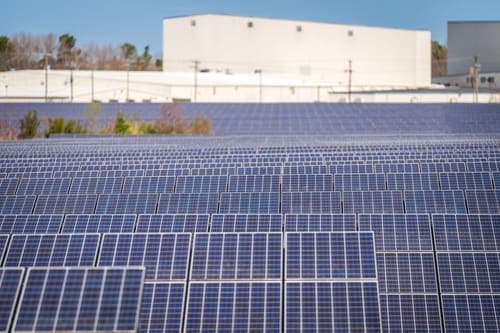
Industrial Solar Panels
Industrial solar panels are the big-format modules, higher wattage each and a lot more of them per row, and they go on warehouse roofs, plant buildings and pre-engineered metal structures out toward the old steel yards in Ensley. On a standing seam roof we clamp to the seam itself and never drill the panel. On a flat membrane we either ballast or flash each penetration, and that call comes off a structural review of the deck instead of a hunch.
Screw into the flat pan between the ribs and you get a slow leak over a production line by the next hard rain.
What swings the cost on commercial solar power at this scale is panel count, roof type, whether steel needs adding, and how far the array sits from your switchgear. A Birmingham Solar Installation on a working plant gets sequenced around your shifts, not ours.
Commercial Solar Solution
A commercial solar solution starts with a year of your billing history, not a roof measurement. I want to see your demand charges and when they spike, because an array sized off kilowatt-hours alone can cut energy use and barely dent demand.
Most of our solar power commercial installations around Birmingham land on low-slope TPO or EPDM, either ballasted or mechanically attached with properly flashed penetrations, and if that membrane is near the end of its life we tell you before a single foot gets bolted down. Warehouses, churches, machine shops, dealerships and self-storage are the buildings that usually call us about commercial solar power.
Roof condition, conduit run length from the array back to your switchgear, lift access and how your utility wants the tie-in handled all push the number around.
Solar Agriculture Water Pump
A solar agriculture water pump is the one job where the math sells itself, because your well sits a quarter mile from the nearest power pole and trenching that run costs more than the whole pump. So we set a small array right at the wellhead, feed a DC submersible through a controller, and skip batteries entirely by pumping into an elevated storage tank. Gravity covers the nights and the gray stretches.
Same industrial solar panels we hang over warehouse roofs, just a handful of them on a pole mount.
Depth to water, daily gallons for the herd or the irrigation lines, and the distance from panels to casing set the array size. Undersize it and the pump stalls and restarts all afternoon, which kills motors. We wire in dry-run protection every time. Cattle operations are commercial solar power customers too.
Solar For Commercial Buildings
Solar for commercial buildings starts with two things I can't size up from the truck: what your roof is built of, and what your bill actually charges you for. On a flat membrane roof we ballast the racking so nothing gets punched through the deck. On standing seam we clamp to the ribs.
If the roof is near the end of its life, we deal with that first, because pulling an array back off to reroof later is money you spend twice.
Demand charges are the part that bites a warehouse, a machine shop, a grocery store. A commercial solar power system sized to shave your afternoon peak looks nothing like one sized to wipe out kilowatt-hours, so we pull a year of interval data before we draw anything. Roof type, array size, lift access and the cable run to your switchgear move the price most.
Solar Farm Maintenance
Solar farm maintenance is the part nobody budgets attention for until production drops and nobody on site can say why. We monitor at the string level, so when a combiner drops offline we catch it that week instead of at the next utility bill.
Twice a year we walk the rows: torque checks on racking hardware, washing the yellow pine pollen film off the glass before the summer sun bakes it into a haze, thermal scanning for hot cells, cleaning inverter filters and fans, and cutting vegetation back before it shades the bottom of a module. Corroded connectors and ground faults are what we find most.
What moves the number is acreage, row spacing, whether the ground can be mowed or has to be trimmed by hand, and how often you want us out.
Let it slide and a commercial solar power array bleeds output while your warranty file sits empty.
Solar Farm Battery Storage
Solar farm battery storage is what turns a field of panels into something you can lean on at four in the afternoon, when the array is fading and your demand charge is still wide awake. We set lithium iron phosphate cabinets on a poured pad, run conduit back to a hybrid inverter, and wire your critical loads through a transfer arrangement so the coolers and compressors ride through while the rest of the site sits dark.
Usable kilowatt-hours, how many circuits you want held up, and how far the cabinets sit from your switchgear are what move the number.
Done badly, batteries cook. A cabinet shoved against a west wall with no clearance on a hundred degree afternoon loses capacity years early. Storage folds into the same solar farm maintenance rounds, because a bank with one sulking module reads fine right up until the lights go.
Solar Farm Tax Credit
The solar farm tax credit is the reason a lot of these projects pencil out, and it turns on paperwork at least as much as panels. What I keep for you is the itemized equipment and labor breakdown, the permit records, the commissioning report, and the date the utility granted permission to energize. That last date matters, because it tells your CPA which tax year the credit belongs to.
A system switched on the first week of January sits a whole filing season away from one switched on in late December, and I've seen an inspection slip push a project across that line.
Battery is its own animal on the tax side, so I list solar farm battery storage as a separate line rather than burying it in a single total for commercial solar power.
I'm not your accountant and I won't play one. What I will not do is hand you an invoice that reads "solar system, installed" and leave your tax preparer guessing at the numbers.
What the job involves
Commercial solar power starts with a structural look, not a sales pitch. We get on the roof, check what the membrane is made of and how much life is left in it, then work out whether your bar joists can carry a ballasted rack or whether we're mechanically attaching and flashing every single penetration.
After that it's the electrical side: how far the array sits from your switchgear, what your three-phase service can handle, and what the power company needs to see before they'll let you send anything back down their lines.
That's where the money moves too. Roof condition, structure, conduit runs, and on a ground mount, how deep the solar farm tax credit paperwork goes.
Done badly, you get a leak nobody spots until the next storm and inverters baking in full west sun, clipping every summer afternoon. A commercial array runs weeks, not a morning.
What it costs
Commercial solar power here runs about $4.47 per watt installed, so a 50 kW array on a warehouse roof lands somewhere near $220,000 before any incentives. What moves that number is how many roof penetrations we can avoid with ballasted racking, whether your switchgear has spare capacity or needs a new service, and how long the DC run is from the array back to the inverters.
A solar agriculture water pump is a different scale of job altogether: a small DC array, a pump controller, no grid tie, no utility study.
Call us with twelve months of power bills and the age of the roof and we'll price your building specifically.
The cheap bid skips the structural letter and sets panels over a membrane with five years left in it. Then you pay a crew to pull them all off to reroof.
When commercial solar power is the wrong fix
Commercial solar power is the wrong fix more often than you'd think, and I'd rather say so now than after the racking is on your roof. If your bills are reasonable and your actual gripe is losing power twice a summer when the storms roll through, panels won't save you. They shut down with the grid. What you want there is solar battery backup, or a home generator installation sized to your critical circuits.
Same story if most of your load is hot water. A commissary kitchen or a laundry gets more back from solar water heater installation than from a roof full of modules.
If the real ask is charging vans overnight, that's ev charger installation and a service upgrade. And if there's no utility service at the property line at all, price an off grid solar system.
Why choose us for this
You have a building, a power bill that climbs every month, and two or three quotes for commercial solar power that do not agree with each other on size, panel count or payback. What you actually want is to hire once, not supervise anybody, and not think about that roof again for years.
The cheaper number usually gets there by leaving things off the sheet. No structural check on the roof framing before racking goes down. No allowance for the interconnection paperwork with the utility. Both come back later as a redesign or as a finished array sitting switched off, waiting on an approval nobody filed. We put them in the quote at the start, which makes our figure read high on the phone and hold steady on the invoice.
A site visit costs you nothing and commits you to nothing.
Frequently asked questions
Will mounting panels damage my roof?
Not if the array is designed around the roof you actually have. Commercial solar power on a flat membrane usually means ballasted trays that weigh the panels down instead of punching holes in it, and where a penetration is unavoidable it gets flashed and sealed properly. We check the membrane's remaining life before anything goes up.
What can't I run off solar?
Nothing inside the building cares where the electrons come from. The limit is outages: a grid-tied array shuts off with the utility, so coolers and card readers go dark unless there's battery storage behind it.
Why do some businesses pull their panels out?
Almost always because the system was undersized for the load, or it went onto a roof with five years left in it. Inverters are the part that ages first, so plan on a swap around year twelve.
Contact Birmingham Solar Installation now
If you own a building with a wide roof and a summer demand charge that stings, commercial solar power starts with a site visit, not a brochure. Call us at (205) 883-0490 and we'll set a time to walk the roof, open the switchgear, and see what your service can actually carry.
Have twelve months of utility bills handy. That usage curve, plus your demand charges, tells us whether the array should chase your afternoon peak or simply grind down kilowatt-hours all day.
The part that drags a commercial solar power job out is the interconnection application, and no utility has ever hurried for anyone. We file early. We also pull a structural review before anything gets racked, because an older bar joist deck under a warehouse off Finley can carry less ballast than it looks like it should.