Your July power bill costs more than your car note, and that roof just sits up there sunbathing.
Home solar installation is what we do all day, mostly roof mounted solar panels on houses from Vestavia over to Trussville. We won't quote a system we haven't stood on. Shingle age matters, roof pitch matters, and those pines shading your southwest slope matter a good deal more than any brochure admits.
What moves your number is array size, how many panels fit before shade starts eating your production, and whether your service panel can take a backfeed breaker or needs upgrading first. Compare bids on solar cost per watt rather than the big figure on the cover sheet, because that's where the real difference between two proposals hides.
Further down there's what the install actually involves, what it runs, the federal credit everybody asks about, and the questions folks put to me before they sign anything. Give us a ring and we'll get up on your roof and tell you whether yours is a good candidate.
Federal Solar Tax Credit
The federal solar tax credit is the biggest single thing that changes what a home solar installation actually costs you, and it doesn't work the way most folks assume. It's a credit against what you owe on your federal return, not a check in the mail, so how much of it you can actually use depends on your own tax picture. Talk to whoever files your return before you sign anything with anybody.
Leasing is where this gets misread. If you lease, you don't claim the credit, the company that owns the panels does. So when you weigh a leasing solar panels cost against owning the system outright, the monthly figure is only half of what you're comparing.
And new shingles don't count. If we're doing a roof and solar panel installation together, the roofing sits on your side of the ledger while the modules, racking, inverter, conduit and the labor to set them belong to the credit. We hand over an itemized invoice and the equipment list so your preparer isn't guessing which line goes where on a Birmingham Solar Installation.
Benefits Of Solar Power
Steadier summer bills: The plainest of the benefits of solar power is that the utility's rate hikes stop landing on you in full. A July afternoon in Birmingham has your AC running most of the day, and that is exactly the window when the array is producing hardest. Wait another year and you pay retail for another set of hot months.
Owning it, not renting it: Leasing solar panels cost you the federal solar tax credit, because the leasing company claims it instead of you. A home solar installation you own also keeps a future sale simple, since a buyer's lender never has to sit down and read somebody else's twenty-year contract before closing.
Shade on your shingles: This is the one nobody asks about. Panels stand a few inches off the roof and cover the deck through the worst of the afternoon, so the shingles and the attic underneath run cooler. That is less heat soaking down into your ceiling insulation while the air conditioner is already fighting it.
Roof Mounted Solar Panels
Most of the home solar installation work we do around here is roof mounted solar panels, and the part that matters is what happens underneath them. Every mount lands in a rafter, not in decking, so we locate framing before anything gets drilled.
Each hole gets a flashed mount tucked up under the shingle course above it, which means water runs over metal instead of over a blob of sealant that gives up after three summers of heat on a south slope.
Layout follows your roof, not a brochure. South and west planes carry the most production, and one big water oak on the southwest corner can drag a whole string down, so we map shade before committing to a panel count. Rails get spaced for the panel and the wind load, conduit runs where you will not see it from the curb, and the inverter goes somewhere a person can actually service it.
The benefits of solar power hold up for decades or don't, and flashing is usually the deciding factor. Size, pitch, framing and attic access move the price.
Roof And Solar Panel Installation
Before we talk panels, we get up on the roof, because roof and solar panel installation is one job, not two. An array with twenty-five years in it sitting on shingles with five years left turns a home solar installation into something you pay for twice, once to put it up and again to pull it off and set it back down.
So we look at the decking for soft spots, the shingle age and how many layers are stacked up there, and where the rafters actually run, because every mount has to land in wood, not in decking that just feels solid under a boot. Each foot gets flashed under the course above it and sealed properly. Skip that and you get a brown ring on a bedroom ceiling after the first real spring thunderstorm.
Some of those Forest Park bungalows carry three layers of shingle, which changes the hardware we use. Pitch, story height, how many roof planes the array has to be split across, and whether the old shingles come off first are what move the solar panel installation cost.
What the job involves
A home solar installation starts on your roof with a tape measure and an attic light, because everything after that depends on where the rafters actually run and what shape the decking is in. We map rafters, check the main panel for breaker room, and read the shade coming off the trees nobody wants cut down. That site visit takes a morning.
Then permits and the utility interconnection paperwork, which is the slow stretch and mostly waiting on other people.
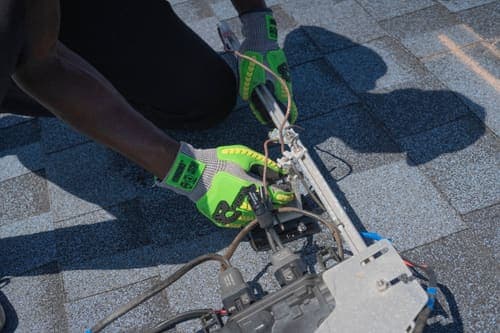
Mounting day is the loud part. Flashed lag bolts into rafters, racking squared and rails set, panels and inverters wired, conduit run down to the service panel, then inspection before the meter gets swapped.
What we will not do is sink racking into bare plywood decking because finding the rafter took longer. That holds up fine until the first hard storm, and then you have water tracking down a rafter and a roof repair sitting on top of your solar panel installation cost.
What it costs
What it costs starts with how many kilowatts you actually need, and that number comes off twelve months of power bills, not one scorching month. A home solar installation sized off a single summer bill is usually too big, and then you have paid for panels that spend the mild months selling power back for pennies.
After size, the two things that move solar panels for home cost most are the roof and the electrical. One wide asphalt shingle plane facing south is the simple version. Standing seam metal, slate, a roof broken into five small faces, or a pair of water oaks dropping afternoon shade across the back slope all mean more racking, more labor, and often microinverters rather than one string inverter.
A tired main panel with no room left in it means a service upgrade before a single module goes up.
Call us with your address and a recent bill and we can put a real number on your own roof.
Battery backup prices separately, and most folks add it after their first long outage rather than before.
When home solar installation is the wrong fix
Sometimes home solar installation is the wrong fix, and it is a lot cheaper to hear that standing in the yard than after the racking is bolted down. If your roof sits under mature oaks and the sun only reaches it between about eleven and two, an array will make a fraction of what any model promises, and you will be irritated about it for twenty years.
Nothing brings solar panels for home cost down like not buying panels that spend the afternoon in shade.
If the real worry is the lights going out, panels by themselves shut off with the grid, every time. What you want there is solar battery backup, or home generator installation if the goal is running the whole house through a storm without rationing what you plug in.
Want cheaper showers and nothing else? A solar water heater installation is a smaller, simpler job. Want to charge the car? An ev charger installation on its own circuit does that now. And if this is a shop or a warehouse, commercial solar power gets sized off your demand charges, not your roof.
Why choose us for this
You've got a power bill that keeps creeping up, a roof facing the right way doing nothing, and no interest in babysitting a home solar installation for a month.
Price on this one comes down to how many panels your usage actually calls for, how steep and cut up the roof is, whether the breaker box has room for the backfeed, and how far the run is from the array down to the service. A bid that lands well under mine usually got there by leaving something off the sheet: the panel upgrade, the conduit, the permit fees.
Those come back as a change order once the racking is already up there.
What I won't do is set a mount without hitting solid framing and flashing that penetration up under the shingle course above it. Solar energy panels for home use sit out in the weather for decades, and a lazy penetration turns into a ceiling stain the first time a storm parks over the valley.
The estimate costs you nothing and doesn't obligate you to book.
Frequently asked questions
Will drilling into my roof cause leaks?
No, not when the home solar installation is done properly. We find the framing, lag the mounts into solid wood, and flash every penetration so it tucks under the shingle course above it, the same way a plumbing vent is handled. Leaks come from mounts sunk into bare decking with a blob of sealant over the top. If your shingles are past fifteen years or curling at the edges, I'd sooner you reroof first.
Are there appliances that can't run on solar?
No. The inverter turns DC into ordinary household AC, so your range, dryer and window units never know where it came from. The limit shows up with battery backup, where a three-ton compressor kicking on during a humid afternoon pulls a surge that a small battery can't cover.
Why do people take their solar panels back off?
Usually the roof, not the array. Solar energy panels for home use outlive shingles, so a tired roof means removal and reinstallation later.
Contact Birmingham Solar Installation now
Ready to get a Birmingham solar installation on the calendar? The first step is us up on the roof with a tape and a shade reading, not somebody at your kitchen table with a tablet and a countdown timer. We measure the usable south and west planes, check rafter spacing and the condition of your shingles, and pull a full year of your power usage so the array gets sized to what your house actually burns.
Most home solar installation jobs here start with that site visit and finish with the utility granting permission to operate, and the permitting and interconnection paperwork in between is ours to chase, not yours.
One thing worth knowing before you dial: bigger arrays usually land at a better solar cost per watt, because the permit fee, the inspection and the crew day cost about the same whether we hang twelve panels or thirty.
Call us at (205) 883-0490. Somebody is here nine to five, Monday through Friday, and messages get called back.